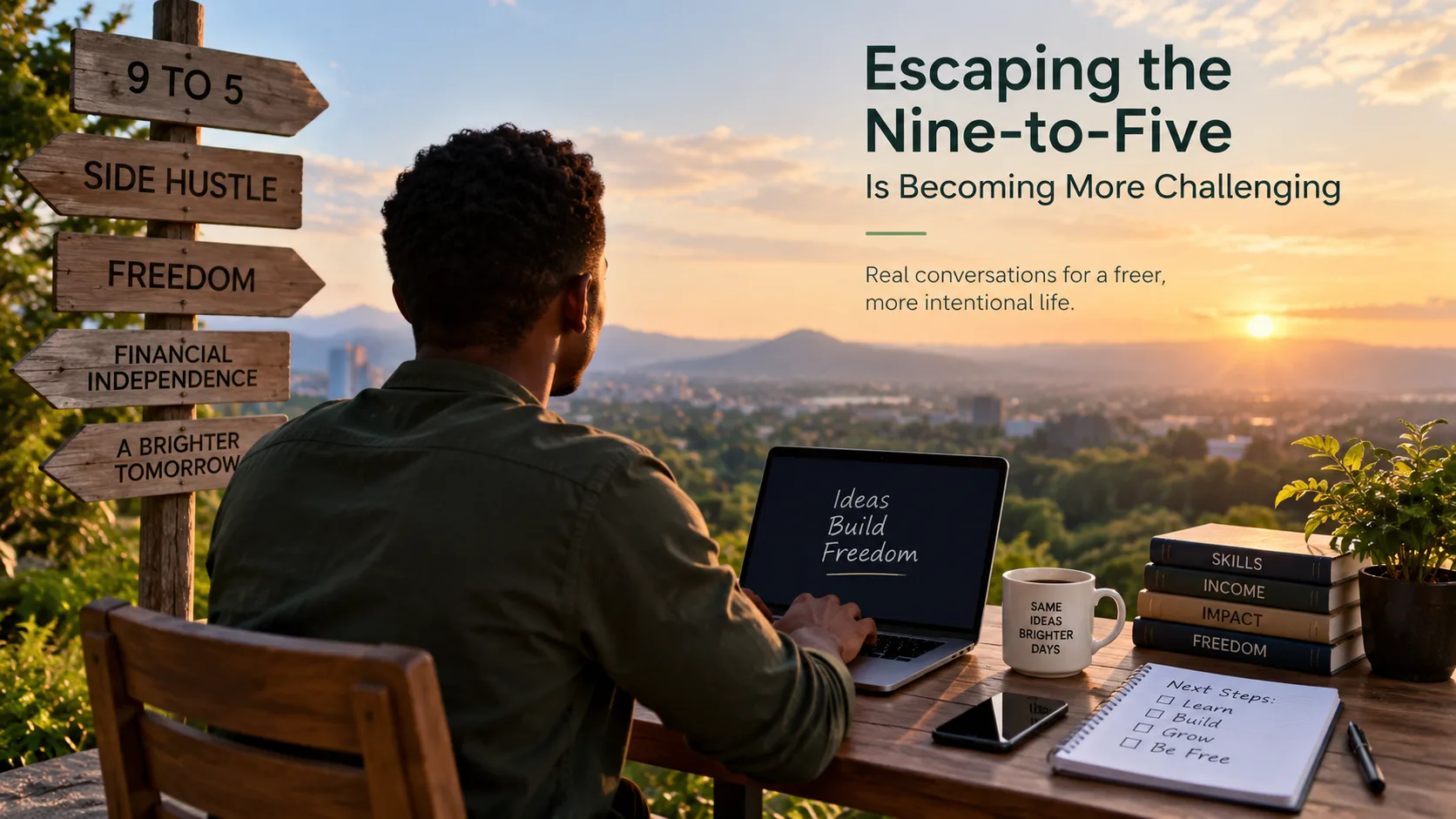
For years, escaping the nine-to-five has been sold as a simple formula: learn a valuable skill, start a side hustle, build an online business, quit your job, and enjoy freedom.
The internet is full of stories about freelancers working from anywhere, founders building companies from their laptops, creators earning independently, and entrepreneurs walking away from traditional employment.
It sounds appealing. And for some people, it works.
But the reality is more complicated.
Escaping the nine-to-five is becoming more challenging — not because opportunities have disappeared, but because turning those opportunities into reliable, sustainable income is increasingly difficult.
The Dream of Leaving the Nine-to-Five
Traditional employment provides something that is easy to underestimate: predictability.
You generally know when you will work, how much you will earn, and when your salary will arrive.
Entrepreneurship changes that equation. Instead of exchanging your time for a relatively predictable salary, you accept uncertainty in exchange for the possibility of greater independence and financial upside.
That trade can be worthwhile, but leaving your job does not automatically create freedom.
Sometimes you simply replace one boss with customers, deadlines, invoices, algorithms, app stores, payment processors, marketing campaigns, and bills.
Real independence requires more than quitting. It requires building something sustainable.
The Cost of Freedom Is Getting Higher
One of the biggest challenges is straightforward: life is expensive.
Housing, food, transportation, internet, healthcare, taxes, software subscriptions, and everyday expenses continue whether your business has a good month or a terrible one.
A salary absorbs some of that uncertainty. Independent work exposes you directly to it.
This is why replacing a salary requires more than generating the equivalent in business revenue. A business typically carries operating costs, transaction fees, taxes, advertising expenses, subscriptions, equipment costs, and unpredictable slow periods.
Instead of asking:
How quickly can I quit my job?
A better question is:
How can I build enough reliable income that quitting becomes a reasonable decision?
That shift in thinking matters.
Starting Is Easier. Getting Attention Is Harder.
The internet dramatically lowered the barrier to starting a business.
Anyone with an internet connection can start freelancing, publish a newsletter, launch an online store, build an app, sell digital products, or create content for a global audience.
That is an extraordinary opportunity.
It also creates extraordinary competition.
Starting has become easier. Getting noticed has become harder.
When thousands of people can offer similar products and services, simply creating something is no longer enough. You need a strong product, clear differentiation, distribution, trust, and persistence — or some combination of all of them.
The central question has shifted from:
Can I build this?
to:
Can I convince enough people to care about this?
For many entrepreneurs, the second question is far harder to answer.
AI Changes the Equation Again
Artificial intelligence is enabling individuals to accomplish work that once required several specialized skills.
AI can help entrepreneurs research markets, write code, analyze data, brainstorm ideas, create marketing materials, automate repetitive tasks, and support customers.
That gives independent builders enormous leverage.
But there is another side to it.
Everyone else has access to the same tools.
As the cost and difficulty of creating software, content, and digital businesses fall, more products compete for the same customers and the same attention.
AI therefore creates an interesting contradiction: it makes entrepreneurship easier to enter while making differentiation increasingly important.
Knowing how to build still matters.
Knowing what is worth building, who needs it, and how to reach those people matters even more.
Social Media Shows the Result, Not the Process
Success looks deceptively simple when compressed into a social media post.
Someone writes:
I quit my job and built a six-figure business.
What you usually do not see are the failed products, sleepless nights, rejected proposals, unsuccessful launches, years spent developing skills, or months when almost nobody bought anything.
You see the result. You rarely see the full process that produced it.
This creates unrealistic expectations about how quickly financial independence should happen.
Someone who has been building for six months may be comparing themselves with someone who quietly accumulated skills, relationships, experience, capital, and an audience over ten years.
That comparison is rarely useful.
A Side Hustle Can Become a Second Job
The phrase "side hustle" sounds flexible and exciting.
Sometimes it is.
But it can quickly become another job.
You finish your normal workday and then start coding, designing, writing, marketing, answering customers, fixing bugs, editing videos, sending proposals, or managing your business.
Suddenly, escaping the nine-to-five means working nine-to-five and then five-to-midnight.
That may be necessary for a period of time. It should not become the permanent model.
The goal of building independent income should eventually be greater control over your time — not simply maximising the number of hours you work.
Revenue Is Not the Same as Reliable Revenue
Making money from something you created is an important milestone.
Making money consistently is a different challenge.
A business might earn $800 one month, $2,400 the next, $300 after that, and then suddenly $4,000.
It is generating revenue, but that does not necessarily mean it can safely replace a salary.
Before depending entirely on independent income, understand your average revenue, expenses, profit margins, savings, customer concentration, recurring revenue, and how consistently you can acquire new customers.
Financial independence is not simply making money outside a job. It is reaching a level of stability where one difficult month does not destroy everything you have built.
Platforms Can Change the Rules
Many modern businesses are built on infrastructure that entrepreneurs do not control.
- Search engines can change their algorithms.
- Social networks can reduce organic reach.
- App stores can change their policies.
- Advertising costs can rise sharply.
- Payment providers can introduce new restrictions.
- Marketplaces can change their fees.
Platforms are incredibly useful, but depending entirely on one creates real risk.
Whenever possible, build assets you control: your website, brand, products, customer relationships, email audience, reputation, knowledge, and community.
Use platforms for distribution, but avoid making any single platform the entire foundation of your business.
Quitting Your Job Shouldn't Be the First Goal
This may sound counterintuitive in an article about escaping the nine-to-five, but quitting should not necessarily be your first milestone.
Building leverage should be.
A job can provide the income that allows you to experiment without desperation. It can pay your rent while you find your first customers. It can fund the software and equipment you need. It can allow you to reinvest business revenue rather than immediately withdrawing everything to survive.
Sometimes the job you eventually want to leave can temporarily become the investor funding your escape.
There is no shame in building gradually.
Build Skills Before You Build Freedom
Sustainable independence usually flows from valuable skills.
Coding, sales, marketing, writing, design, communication, negotiation, product development, financial management, and leadership can all create opportunities.
The exact combination will differ for everyone. But the underlying principle remains the same:
The market does not pay you because you want freedom. It pays you because you create value.
Skills create options. Options create leverage. And leverage can create freedom.
Stop Chasing Every New Opportunity
One of the easiest ways to stall your progress is to constantly chase whatever business model is currently popular.
One month it is dropshipping. Then affiliate marketing. Then a YouTube channel. Then an AI agency. Then an app. Then a newsletter.
Every switch can reset part of your progress. You have to learn another market, another customer, another product, and another distribution channel from scratch.
Experimentation is useful when you are searching for something that works. Endless switching is not.
When you find something showing genuine demand, give it enough attention and time to grow.
Build the Bridge Before You Jump
For many people, the safest route out of traditional employment is not a dramatic resignation. It is building a bridge.
- Develop valuable skills while you still have income.
- Build something small.
- Find your first customer, then find another.
- Learn why people buy.
- Improve the product.
- Build distribution.
- Save money.
- Track your revenue.
- Reduce unnecessary expenses.
- Create systems.
- Increase recurring income.
Then decide whether your independent income has become sustainable enough to support you.
There will never be a completely risk-free moment to become independent. But there is a significant difference between taking a calculated risk and simply hoping everything works out.
What Does Freedom Actually Mean?
Perhaps the biggest mistake is defining freedom entirely as not having a job.
Someone earning a good salary, working remotely, controlling their schedule, and having enough time for family and personal projects may have more genuine freedom than an entrepreneur working sixteen hours a day to keep a struggling business alive.
Freedom is personal.
- For one person, it might mean building a company.
- For another, freelancing.
- For another, remote employment.
- For someone else, it might simply mean working fewer hours while earning enough to live comfortably.
The goal should not be to copy someone else's version of success. It should be to create a life with the combination of income, autonomy, security, purpose, and time that matters to you.
Escaping the Nine-to-Five Is Still Possible
Escaping the nine-to-five is harder than many online success stories make it appear.
But harder does not mean impossible.
The tools available to individuals today are extraordinary. One person can build software and distribute it globally. A freelancer in Kenya can work with companies on another continent. A writer can reach readers around the world without owning a printing press. A small digital business can serve customers almost anywhere.
The opportunity is real.
What is disappearing is the illusion that access to opportunity automatically produces success.
Sustainable independence takes skills, patience, financial discipline, distribution, adaptability, and enough persistence for your work to compound over time.
Escaping the nine-to-five was never really about escaping work.
It is about gaining greater control over what you work on, who you work with, when you work, and what your work can become.
That kind of freedom is still possible.
It just has to be built.