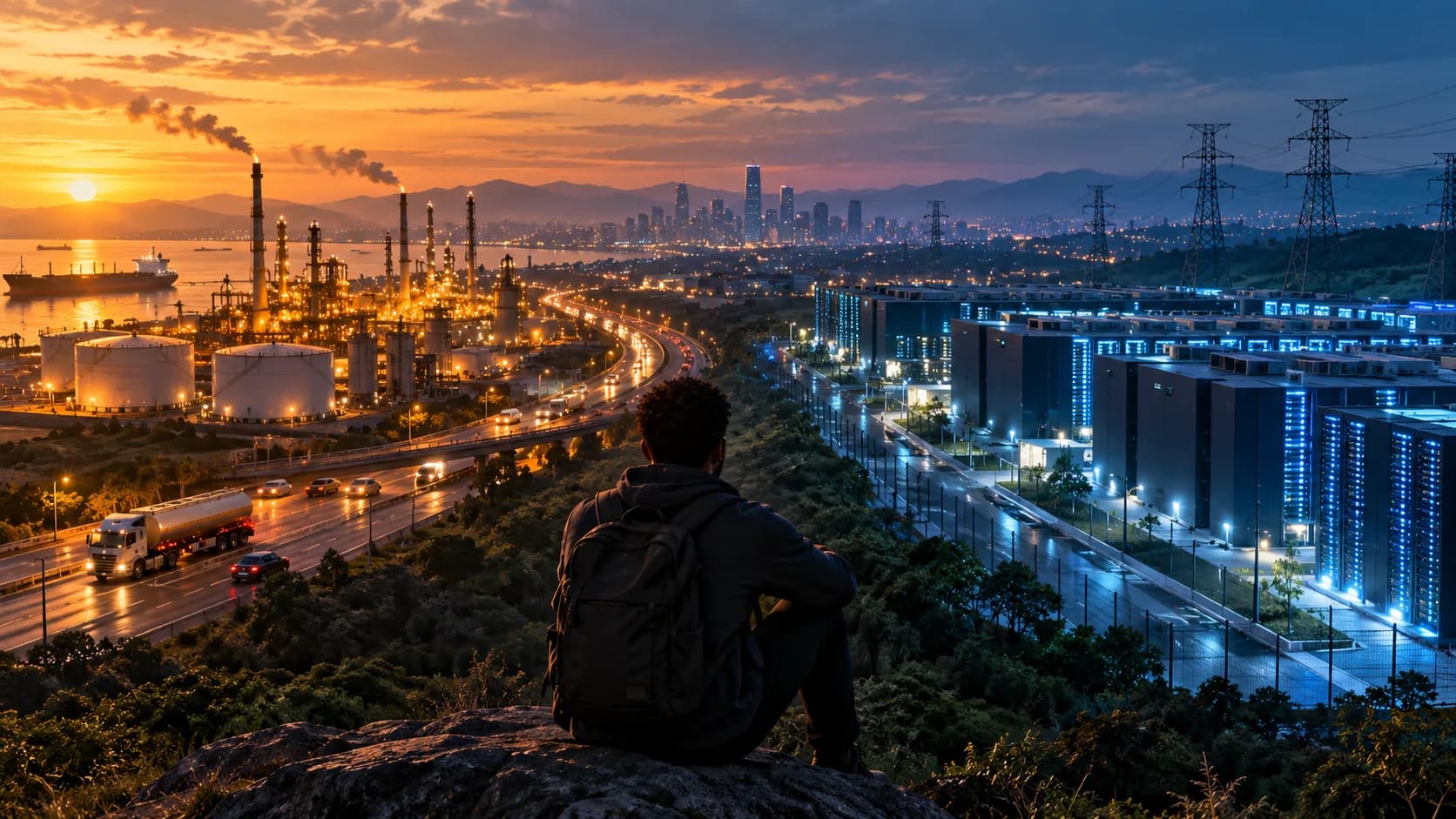
I've had this question sitting in my head lately. And I don't have a clever answer for it.
What do you think is one of the biggest problems we're creating in the world right now?
Not the problems we've inherited. Not something that's been on the list for the last fifty years. I mean something happening right now that we might look back on years from now and wonder: how did we not see where this was going?
I've been trying to answer it myself. I have two. And I'm not even sure they're the right ones.
My first answer: petroleum
This one feels almost too obvious.
We've known about our dependence on petroleum for a very long time. Yet whenever something happens that threatens oil supply, suddenly the whole world seems to remember just how much still depends on it.
Fuel. Transport. Flights. Shipping. Manufacturing. Food getting from one place to another. Prices. Entire economies.
A problem thousands of kilometres away can eventually arrive at a petrol station near you. That's strange when you think about it.
We've built AI that can generate videos from a single sentence. Cars that can drive themselves. Rockets that can land themselves. Computers that fit in our pockets and connect us to almost anyone on Earth.
And yet one of the most important questions in the global economy can still be: how much is a barrel of oil today?
I'm not saying I know how we fix that. I don't. Replacing something the world has spent more than a century building around probably isn't as simple as saying: let's just use something else.
But that's exactly why it makes my list. We know the dependency exists. We know it creates problems. And somehow we still need it enough that when petroleum sneezes, a lot of the world reaches for a tissue.
My second answer: data centres
This one feels strange to put next to petroleum.
A data centre doesn't look like a global problem. Most of us never even see one. We just see the things it gives us.
Google. Cloud storage. Streaming. Apps. AI. ChatGPT. The website you're reading this on.
Tap something — something happens. Ask something — an answer appears. Upload something — it's suddenly "in the cloud."
The word *cloud* might actually be part of the problem. It makes everything sound like it's floating somewhere. Weightless. Almost free.
But the cloud has buildings. The buildings have servers. The servers need electricity. They produce heat. They need cooling. And as we ask computers to do more and more, we're building more places to make all of that happen.
The International Energy Agency estimates data centres used around 415 TWh of electricity in 2024 and projects their consumption could more than double to around 945 TWh by 2030. AI is an important driver of that growth, although data centres are still only one part of much larger global electricity demand.
That number caught my attention. Not because I fully understand what 945 TWh feels like — I don't. Maybe that's part of what makes this difficult to think about. We use things whose physical cost we almost never see.
And yes, I'm writing this using one of them
That's the slightly embarrassing part. 😂
It would be easy for me to write a dramatic paragraph about data centres consuming electricity — while using AI, on a cloud-connected device, publishing to a website hosted on a server somewhere, probably checking LinkedIn afterwards.
I'm not outside the problem. I'm literally clicking my way through it.
And I don't particularly want to stop. I like AI. I build software. I want better technology, faster systems, cheaper computing. I want to see what becomes possible when these tools keep improving.
Which creates a question I don't really know how to answer: what happens when billions of us want the same thing?
One AI request doesn't feel like much. One video doesn't feel like much. One cloud backup doesn't feel like much. One person driving to work doesn't feel like much either.
Maybe that's how some of the biggest problems become difficult to notice. Individually, our actions look tiny. Collectively, they become infrastructure.
Then I noticed something odd about my two answers
Petroleum is an old dependency we're trying to reduce. Data centres are part of a new dependency we're rapidly building.
One belongs to the world we keep saying we need to move beyond. The other belongs to the future we can't seem to build quickly enough.
But both eventually ask us for the same thing: energy.
And that's where my original question became another question. What if the problem isn't petroleum? What if it isn't data centres either? What if I'm looking at two symptoms of something much bigger?
Our appetite.
We want to move more. Build more. Compute more. Generate more. Store more. Stream more. Travel more. Cool more buildings. Automate more work. Give more people access to technology. And hopefully improve the lives of billions of people who understandably want the same conveniences others already have.
None of those things sound unreasonable on their own. That's what makes the question interesting.
I don't know what the third answer is
Maybe you do.
Maybe it's water. Maybe it's misinformation. Maybe it's ageing populations. Maybe it's electronic waste. Maybe it's something happening with food. Maybe it's AI itself. Maybe petroleum and data centres wouldn't even make your list.
I'm not trying to rank the world's problems — I'm definitely not qualified to do that. I'm more interested in the things we're doing today that might look completely different when viewed from 2040.
Because the biggest problem might not arrive looking like a problem. It might arrive looking like convenience. Progress. Growth. A new product. A cheaper service. A technology everybody wants.
Something useful enough that nobody wants to be the person saying: wait — what happens if everyone starts doing this?
And maybe that's the question I've actually been trying to ask. Not: what is wrong with the world? But:
What are we doing extremely well today that could become a serious problem if we keep doing more of it?
I have two answers so far.
- Our continued dependence on petroleum.
- The incredible speed at which we're building a world that needs more data centres, more computing, and more electricity.
I could be completely wrong about both.
So I'm curious — what's your answer? What is one thing happening right now that you think we'll look back on years from now and say: we should have paid more attention to that?