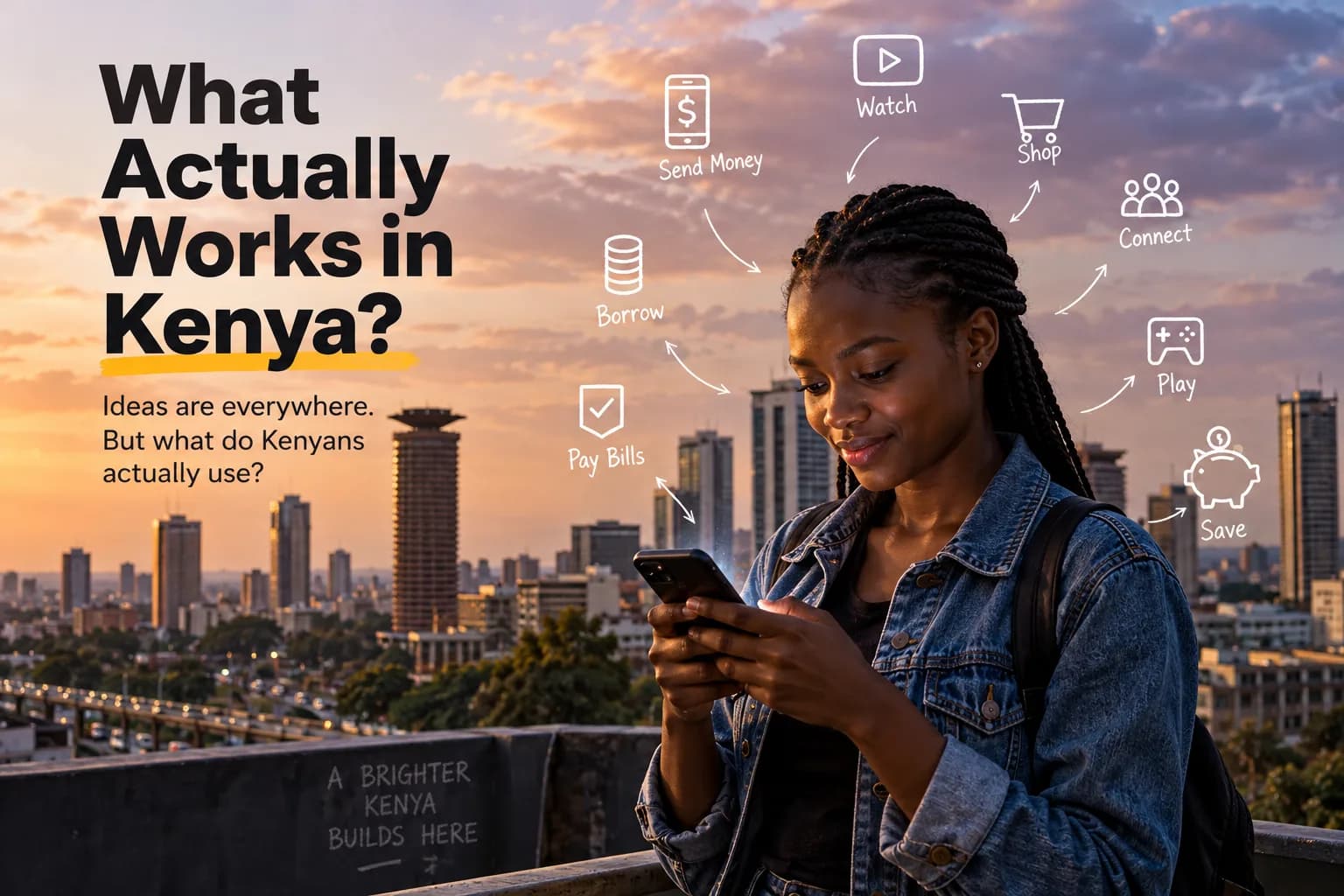
Ask a group of people for startup ideas for Kenya and you will probably get some very respectable answers.
Agriculture.
Education.
Healthcare.
Waste management.
A marketplace connecting farmers directly to buyers.
An app helping small businesses keep records.
Maybe something involving AI, because apparently every startup now needs AI somewhere in the sentence.
They are not bad ideas.
Some are genuinely important problems worth solving.
But I started wondering about a slightly different question.
What do Kenyans actually use?
Not what should work.
Not what sounds impressive in a pitch competition.
Not what makes a beautiful startup deck.
What gets opened again tomorrow?
What gets paid for?
What becomes a habit?
That question leads somewhere much more interesting.
Follow the behaviour, not the ideas
Look at the products that have managed to become deeply embedded in everyday Kenyan life and certain patterns start appearing.
Money is a big one.
Credit is another.
Betting has historically attracted enormous attention.
Entertainment keeps finding audiences.
Social platforms consume hours.
Mobile money became infrastructure.
People pay for convenience when the inconvenience hurts enough.
And when money becomes tight, access to money itself becomes a product.
That is part of the reason digital lending became such a visible category in Kenya.
The interesting lesson isn't:
"Build another loan app."
Please don't.
The lesson is that successful products often attach themselves to something people are already strongly motivated to do.
Borrow.
Earn.
Save.
Pay.
Watch.
Talk.
Play.
Move.
Eat.
Sell.
Escape boredom.
Make life slightly easier.
Those behaviours existed long before somebody decided to put an app around them.
Maybe we're asking the wrong startup question
The common question is:
"What startup would work in Kenya?"
I don't think that question is specific enough.
A better question might be:
"What are Kenyans already trying to do, repeatedly, despite the existing solutions being frustrating?"
That changes how you look at opportunities.
Instead of inventing behaviour, you start observing it.
A person running a small business with WhatsApp, M-Pesa messages, notebooks and Excel isn't waiting for somebody to introduce them to "digital transformation."
They have already transformed digitally.
Badly.
The opportunity might simply be hiding inside the mess.
The same thing happens when people coordinate deliveries through phone calls.
When landlords reconcile payments manually.
When chama members chase contributions through WhatsApp.
When businesses spend hours matching payments to customers.
When someone uses three different apps and a spreadsheet to accomplish something that should take thirty seconds.
Those aren't futuristic startup ideas.
They're existing behaviours with unnecessary friction.
And friction is interesting.
Kenya doesn't necessarily need another everything-app
There is always a temptation to build something huge.
Payments.
Marketplace.
Chat.
AI.
Delivery.
Bookings.
Wallet.
Rewards.
All inside version one.
I've fallen into the same thinking while building products.
You start with one problem.
Then you realise you could add another feature.
And another.
Suddenly you've built seventeen menu items and still haven't answered the original question:
Why would somebody open this tomorrow?
That question matters more than the feature list.
PikaNini, for example, can have calorie tracking and nutritional tools.
EXORA can have timers, focus sessions and notifications.
But those features aren't automatically reasons for someone to build a habit around either product.
The harder problem is discovering the behaviour underneath the feature.
Why does someone care about what they're eating?
Why does someone keep losing focus?
What happens immediately before they abandon something they intended to finish?
What makes them return?
The product starts getting interesting when those questions become clearer.
The Kenyan opportunity might be hidden in boring things
This is probably my favourite category.
Boring problems.
Nobody wakes up excited about reconciliation software.
Nobody is posting cinematic TikToks about inventory management.
"Today I successfully reconciled 487 transactions 🔥"
Probably not.
But businesses experience these problems every day.
I've seen this while working around ERP implementations, financial systems, integrations and payments.
A small operational problem repeated hundreds of times stops being small.
Ten minutes wasted every day across 50 employees is no longer a ten-minute problem.
A payment that cannot automatically be matched to the right account creates another manual process.
Bad data creates another.
Disconnected systems create another.
Eventually an organisation has people whose unofficial job is moving information from one place to another.
That is where software can become valuable without being exciting.
Sometimes the best startup opportunity isn't creating a new behaviour.
It is removing three steps from an old one.
But consumer products play by different rules
This is where things become difficult.
A business may pay because your software saves money.
A consumer doesn't care about your beautiful efficiency calculation.
They can delete your app in four seconds.
Consumer products compete with TikTok.
WhatsApp.
YouTube.
Games.
Friends.
Football.
Sleep.
And whatever drama is happening online that day.
That's an unfair competition.
But it's reality.
It explains why entertainment can be such a powerful category.
Entertainment doesn't have to convince you that you have a problem.
The desire already exists.
I'm bored.
Tap.
Problem temporarily solved.
Compare that with a productivity app.
"Please develop better habits today so your future self can experience improved outcomes."
Not quite the same dopamine.
😂
Loans reveal something else
Digital lending tells us something interesting too.
People don't necessarily love loan apps.
They love what access to money allows them to do.
Pay rent.
Handle an emergency.
Buy stock.
Cover school expenses.
Get through the week.
The underlying demand isn't the app.
It is liquidity.
That distinction matters enormously when thinking about startup ideas.
Never confuse the product with the underlying desire.
People don't want budgeting software.
They might want to stop wondering where their salary disappeared.
People don't necessarily want calorie tracking.
They may want to understand why their weight isn't changing.
People don't want another merchant dashboard.
They want to know who paid them without spending twenty minutes investigating transactions.
People don't want productivity software.
They want to finish the thing they've been postponing for three weeks.
The startup is the mechanism. The desire is the market.
So what would I build for Kenya?
I'm becoming less interested in answering that question with a specific app idea.
I'd rather start with behaviour.
Find something people already do frequently.
Find where money already moves.
Find where people repeatedly complain.
Find processes being held together by WhatsApp, spreadsheets, phone calls and someone's memory.
Find something people currently solve using an awkward workaround.
Then investigate whether removing that friction is valuable enough for somebody to pay.
That might lead to fintech.
It might lead to entertainment.
Agriculture.
Logistics.
Business software.
Health.
Commerce.
Education.
Or something that doesn't fit neatly into any startup category yet.
The category isn't the opportunity.
The behaviour is.
Kenya probably has enough ideas
Ideas are everywhere.
Execution is harder.
Distribution is harder.
Trust is harder.
Getting the first hundred people to care is harder.
Getting ten of those people to return next week might be harder still.
And getting somebody to actually pay changes the conversation completely.
So the next time someone asks:
"What startup would work in Kenya?"
Maybe don't immediately start brainstorming apps.
Go outside.
Watch how people pay.
Watch how businesses operate.
Look at what people complain about.
Look at what they repeatedly spend money on.
Look at the strange workarounds people have accepted as normal.
Look at where someone's phone, notebook, Excel sheet and M-Pesa messages all meet.
There might already be a startup sitting there.
Not because somebody came up with a brilliant idea.
But because thousands of people are already showing you what they need.
You just have to notice.
And sometimes, when you notice the same friction often enough, you end up trying to build around it.
Money is one of those spaces for us. Saving, lending, payments and the systems around them aren't new behaviours in Kenya. They're already part of everyday life. The interesting question is how much better the experience around them can become.
That's some of the thinking behind KIT-IFMS, our money product.