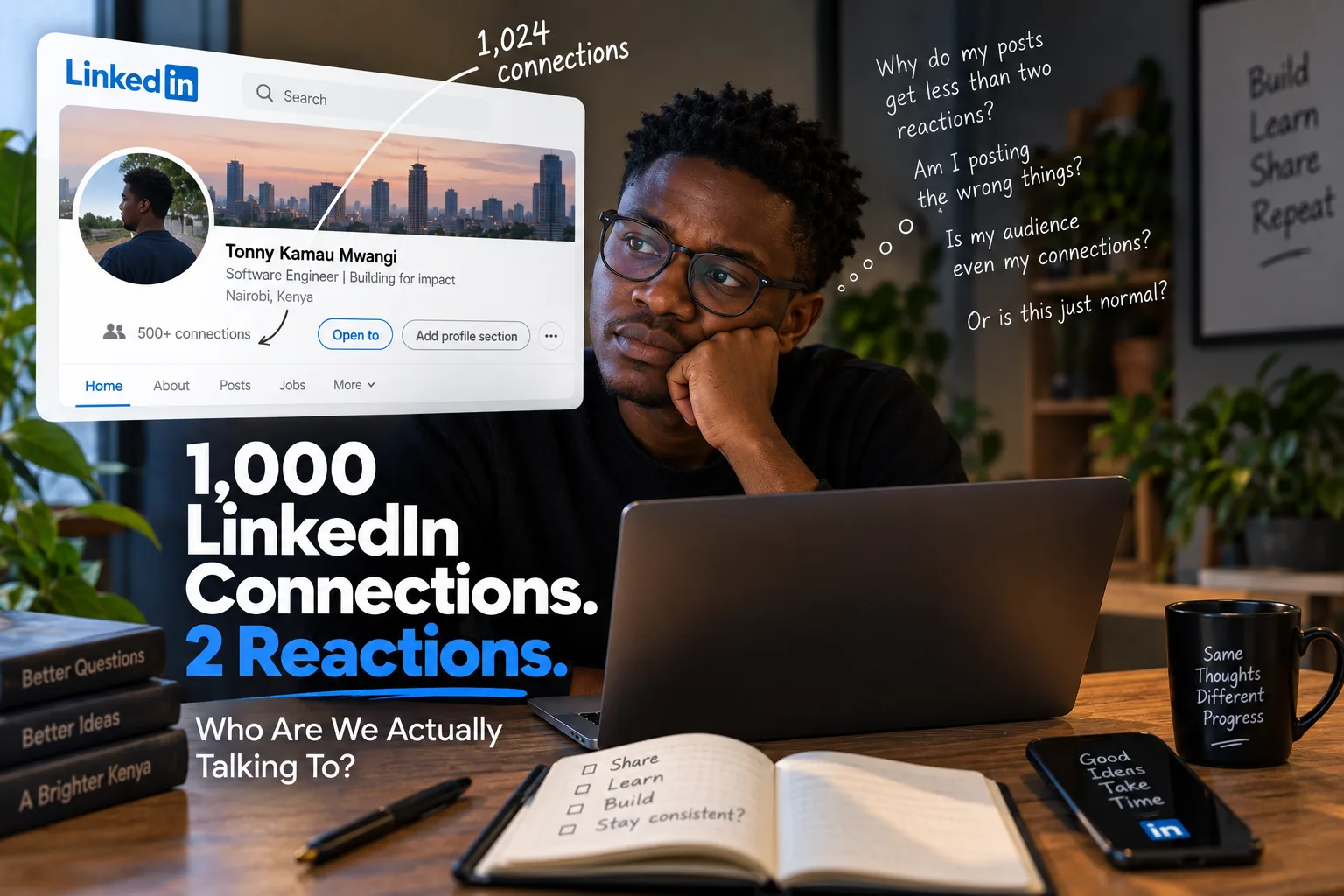
I have.
And sometimes it's funny.
Other times, not so much.
You spend time writing something. Delete the first paragraph. Rewrite it. Read it again. Decide it sounds too robotic. Change it. Finally hit Post.
Then you come back later.
1 reaction.
Maybe 2.
And one of them is from someone who seems to support almost everything you post.
Thank you, whoever you are. 😂
Meanwhile, sitting right above all this is a connection count that suggests there should be considerably more people in the room.
So where is everybody?
I've been thinking about that lately. Not because I've figured out LinkedIn — far from it. I'm still learning how this whole thing works. But the gap between having connections and actually having people's attention is starting to feel much more interesting than the connection count itself.
Maybe connecting isn't the same as caring
This sounds obvious when I write it down. But I don't think I always treated it that way.
Someone connecting with you doesn't necessarily mean they're waiting for your next post. Maybe they connected because you went to the same school. Maybe you worked together. Maybe you sent the request. Maybe they sent it. Maybe they liked one thing you wrote six months ago. Maybe LinkedIn suggested your profile and they thought:
Sure, why not?
Click. Connection made. And then both of you continued with your lives.
We sometimes look at 1,000 connections and imagine 1,000 people sitting in a room waiting for us to speak. But maybe that's not what a connection count represents at all.
I think numbers mess with our expectations
Imagine walking into a room and sharing an idea with ten people. Two respond. You'd probably think: not bad.
Now publish the same thought online. Your profile says 2,000 connections. Two people react to it. Suddenly it feels like you've been rejected by 1,998 people. 😂
But were 2,000 people even shown the post? Did they stop long enough to read it? Were they online? Was the subject relevant to them? Did they read it, agree, and simply continue scrolling?
I don't know. That's the strange thing about posting online. We get very precise numbers without always knowing what those numbers actually mean. And our brains happily fill in the missing explanation — usually with the least flattering one.
Nobody cares.
Maybe. But probably not the whole story.
Sometimes I feel ridiculous posting
I don't see this part discussed as much.
There are days when posting feels completely normal. You have something to say, you write it, you publish it. Done.
Then there are other days. You write something, hover over Post, and suddenly become extremely aware that actual human beings are going to see it. People you know. People you worked with. People who know more about the subject than you. People who might think: why is this person suddenly talking about this?
Sometimes I'll publish something and immediately feel the urge to close LinkedIn. 😂
Don't look at it. Don't check the views. Definitely don't refresh after four minutes.
Then, naturally, I refresh after four minutes.
I don't think that's a marketing problem. I think that's just being human.
Then you see someone else's post
This is where things get dangerous.
You post something. Three reactions. Then five minutes later LinkedIn shows you someone else's post. 842 reactions. Wonderful. Exactly what I needed to see. 😂
And their post can look so effortless. Three sentences. Maybe a picture. Hundreds of people talking underneath it.
It's easy to start comparing. Was my writing bad? Am I talking about the wrong things? Should I post differently? Does LinkedIn hate me personally?
Okay, probably not the last one.
But comparison has a strange way of turning somebody else's successful post into evidence that yours failed. I'm trying not to think about it that way.
Maybe we're writing for an algorithm before we're writing for people
This one bothers me.
Search for advice about getting more reactions and you'll find plenty of rules: use a hook, keep sentences short, post at this time, don't include that, comment before posting, comment after posting, tell a story, use a picture, don't use too many hashtags, ask a question at the end.
Some of that advice probably works. I'm still experimenting with it. But there's a point where you can become so focused on making something perform that you stop sounding like yourself.
I've caught myself doing this. You start writing a normal thought. Then you think: this needs a stronger hook. Then: maybe that paragraph is too long. Then: people won't read this. Eventually your simple thought has gone through so much optimisation that it sounds like every other LinkedIn post you've scrolled past.
And maybe that's worse than getting two reactions.
What if the post wasn't bad?
This is something I'm trying to learn.
Not every good thought gets attention. And not everything that gets attention is necessarily useful. Those are two different measurements.
A post can get very few reactions and still reach the one person who needed it. Someone can read something without reacting to it. Someone can remember your name without commenting. Someone can click through to something you're building. Someone can disagree and think about it for the rest of the afternoon.
None of those things necessarily appear underneath the post as a nice number.
That doesn't mean reactions don't matter. Of course I want people to react to what I write — otherwise I could just keep everything in my Notes app. But maybe reactions are feedback, not a verdict.
I'm still trying to remember that.
Maybe the real question is why I'm posting
This is where I've ended up.
If the only reason I post is to watch a number increase, then every quiet post is going to feel terrible. But there are other reasons to write publicly:
- To document what I'm building.
- To explain something I'm learning.
- To test an idea.
- To meet people interested in the same problems.
- To become better at communicating.
- To look back six months later and see how my thinking changed.
And yes, hopefully, to eventually build an audience that actually cares about some of these things. That last part takes time — probably much longer than we'd like.
A connection count might be the least interesting number
I'm starting to think I'd rather have 50 people who genuinely care about what I'm building than 5,000 connections who vaguely remember accepting my request.
Of course, I'd happily take 5,000 people who care. I'm not turning them away. 😂
But maybe that's the distinction. An audience isn't the same as connections. Connections are a number attached to a profile. An audience is a group of people who recognise what you talk about and choose to come back.
I'm nowhere near figuring out how you build the second one consistently. Right now I'm experimenting — writing, posting, watching what connects, watching what disappears quietly into the LinkedIn feed, and trying again.
So I'll probably keep posting
Some posts will work. Some won't. Some might get two reactions. And yes, I'll probably still check. I'm human.
But I'm becoming more interested in what happens if I keep showing up long enough to find the people who actually care about the same things I do.
Maybe that's what we're really building when we post online. Not connections. Not impressions. Not another number underneath a post.
Familiarity.
Someone sees your name once. Then again. Then again. Eventually they know what you build, what you think about, what you're learning. Maybe one day they stop scrolling.
That's probably worth more than another empty connection.
At least, that's what I'm starting to wonder.
What about you? Have you ever looked at your LinkedIn connection count and wondered where everyone went when you hit Post?